


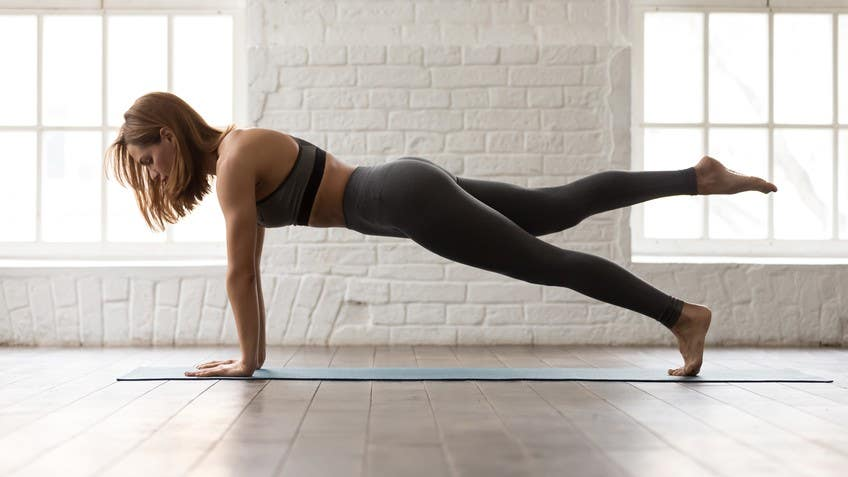
Posture depends on the coordinated strength of muscles across the abdomen, the back, the hips, and the shoulders, working together to keep the spine in a supported and neutral position, and when these muscles are weak or imbalanced, the body compensates through slouching, forward head carriage, or excessive curvature in the lower back, so training the core with intention becomes one of the most effective ways to restore alignment and reduce strain on the joints and connective tissue.
1. Plank
The plank trains the deep abdominal muscles, the lower back, and the shoulder stabilizers simultaneously, holding the body in a straight line from head to heel, and this isometric hold teaches the trunk to resist unwanted movement, which is the same skill required to maintain an upright position throughout the day.
| Step | Instruction |
|---|---|
| Setup | forearms and toes on the ground, elbows under shoulders |
| Position | hips level, ribs drawn down, neck long |
| Hold | 20 to 40 seconds, breathing steadily |
2. Bird Dog
The bird dog challenges the ability to keep the spine stable while the limbs move independently, extending one arm and the opposite leg while balancing on the remaining hand and knee, and this exercise strengthens the muscles that run along the spine and the deep core layer that wraps around the trunk.
| Step | Instruction |
|---|---|
| Setup | hands under shoulders, knees under hips |
| Movement | extend right arm and left leg together |
| Hold | 2 to 3 seconds, then switch sides |
3. Glute Bridge
The glute bridge strengthens the hips and the lower back extensors, lifting the pelvis from the floor while the shoulders and feet remain grounded, and strong glutes reduce the tendency of the lower back to overwork when standing or walking, which directly supports a more upright and stable posture.
| Step | Instruction |
|---|---|
| Setup | lying on the back, knees bent, feet flat |
| Movement | press through the heels, lift the hips |
| Hold | squeeze at the top for 2 seconds, lower slowly |
4. Superman
The superman exercise targets the muscles along the entire back of the body, lifting the arms, chest, and legs off the ground simultaneously while lying face down, and this movement builds endurance in the upper and lower back extensors, which are often underused in people who sit for long periods.
| Step | Instruction |
|---|---|
| Setup | lying face down, arms extended forward |
| Movement | lift chest, arms, and legs together |
| Hold | 2 seconds at the top, lower with control |
5. Wall Angels
Wall angels train the muscles between the shoulder blades and improve the mobility of the upper back and shoulders, standing with the back against a wall and sliding the arms up and down while maintaining contact between the wrists, elbows, and wall, and this exercise directly counters the rounded shoulder position associated with prolonged screen use.
| Step | Instruction |
|---|---|
| Setup | back flat against a wall, feet slightly forward |
| Movement | slide arms upward, keeping contact with the wall |
| Repeat | 10 to 12 slow repetitions |
6. Cat Cow
Cat cow builds awareness of spinal movement through a full range, moving between arching and rounding the back on hands and knees, and while this exercise is often used for mobility, it also reinforces the connection between the diaphragm and the deep core muscles, which supports better control of the trunk during daily movement.
| Step | Instruction |
|---|---|
| Setup | hands under shoulders, knees under hips |
| Movement | arch the back on the inhale, round it on the exhale |
| Repeat | 8 to 10 slow cycles |
7. Resistance Band Row
The resistance band row strengthens the muscles between the shoulder blades and the middle back, pulling the band toward the torso while keeping the elbows close to the body, and this pulling motion balances the pushing movements that dominate most daily activity, which helps prevent the shoulders from rounding forward over time.
| Step | Instruction |
|---|---|
| Setup | band anchored at chest height, arms extended |
| Movement | pull elbows back, squeeze shoulder blades together |
| Repeat | 12 to 15 repetitions |
8. Dead Bug
The dead bug trains the deep abdominal muscles to control the position of the spine while the arms and legs move away from the body, lying on the back with the knees bent at ninety degrees and slowly lowering one arm and the opposite leg toward the floor, and this exercise builds the kind of trunk control needed to keep the lower back supported during standing, walking, and lifting.
| Step | Instruction |
|---|---|
| Setup | lying on the back, arms up, knees bent at ninety degrees |
| Movement | lower right arm and left leg toward the floor |
| Return | bring back to start, switch sides |
Building These Into a Routine
These eight exercises can be combined into a short circuit performed three to four times a week, with two to three sets of each movement, and consistency across weeks produces far greater improvement than intensity in any single session, since the muscles responsible for posture respond best to steady and repeated loading rather than occasional maximal effort.
Breathing plays a supporting role throughout each of these exercises, since shallow or held breathing increases tension in the neck and shoulders, while steady breathing allows the deep core muscles to engage properly and support the spine from the inside, which is a detail often overlooked in general strength training.
Posture is not achieved through a single exercise or a single week of training, but through the gradual strengthening of the muscles that surround and support the spine, the hips, and the shoulders, and the eight movements described above address every major region involved in maintaining an upright and balanced body position.
Albert Mckennie is a strength and conditioning coach, author, and speaker with experience training athletes and general fitness clients.