

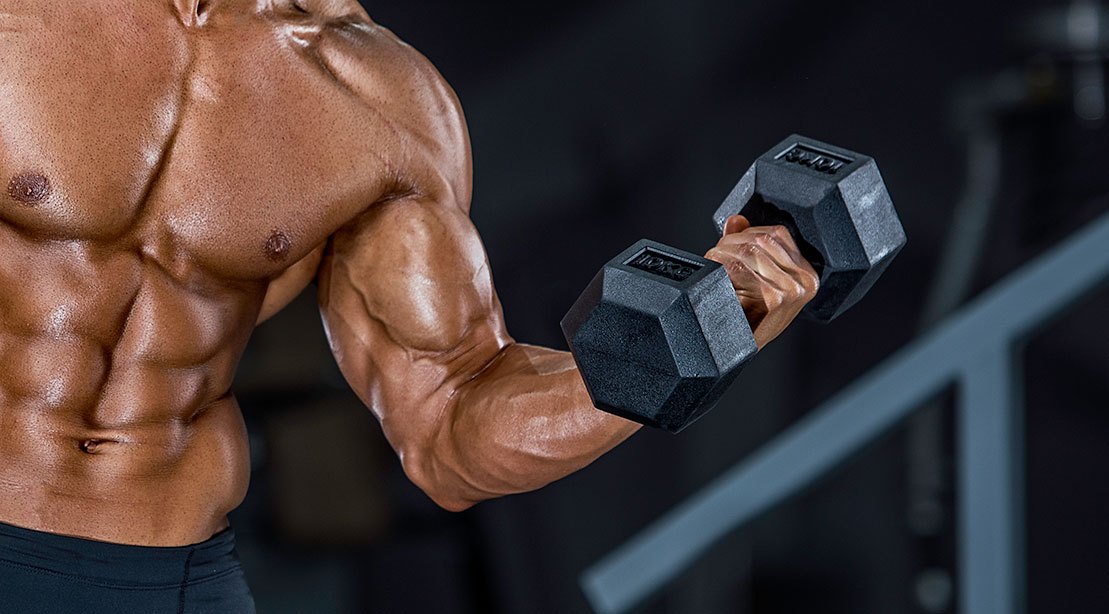
The biceps brachii, along with the brachialis and brachioradialis, respond well to dumbbell training because free weights allow a full range of motion and force each arm to work independently, the article breaks down 7 Bicep Workouts With Dumbbells, including neutral-grip and rotational curl variations that train the biceps brachii alongside the brachialis and brachioradialis muscles.
7 Effective Bicep Workouts With Dumbbells
1. Standing Dumbbell Bicep Curl
The standing curl is the primary movement for isolating the biceps brachii. Standing with feet shoulder-width apart, elbows pinned to the torso, the lifter raises both dumbbells while keeping wrists neutral. Strict form prevents momentum from the shoulders or lower back, keeping tension on the arm muscles throughout the lift.
| Sets | Reps | Rest |
|---|---|---|
| 3-4 | 8-12 | 60-90 sec |
Research on elbow flexor training shows that strict standing curls produce high activation levels in the short and long heads of the biceps when the elbow stays fixed against the body during the entire lift.
2. Seated Dumbbell Curl
Performing the curl seated removes the ability to sway the torso backward, a common cheat used to swing heavier weights upward. This seated position isolates the arm flexors further and suits lifters recovering from lower back strain. A bench with back support adds stability for higher-load training sessions.
| Sets | Reps | Rest |
|---|---|---|
| 3 | 10-15 | 60 sec |
Seated positioning also allows lifters to focus attention on the squeeze at the top of the curl, holding the peak contraction for one to two seconds before lowering the dumbbells with control.
3. Incline Dumbbell Curl
Lying back on an incline bench set between 45 and 60 degrees places the arms behind the torso line, stretching the long head of the biceps at the bottom position. This stretched starting point increases the muscle fiber recruitment compared to standing variations, according to biomechanical studies on arm positioning.
| Sets | Reps | Rest |
|---|---|---|
| 3 | 10-12 | 75 sec |
Because the incline angle limits the ability to use momentum, lighter dumbbells than a standing curl are typically required. Lifters should lower the weight slowly, taking two to three seconds per repetition, to maximize the stretch benefit at the bottom.
4. Hammer Curl
The hammer curl positions the palms facing inward toward the body throughout the lift, rather than facing upward. This neutral grip shifts a portion of the workload onto the brachialis and brachioradialis, two muscles that add width and thickness to the forearm and upper arm area.
| Sets | Reps | Rest |
|---|---|---|
| 3-4 | 10-12 | 60 sec |
Grip strength also improves from consistent hammer curl training since the neutral hand position recruits the forearm flexors more directly than a supinated curl grip. Many strength coaches recommend alternating hammer curls with standard curls across a weekly split.
5. Concentration Curl
Seated on a bench, the lifter braces one elbow against the inner thigh and curls a single dumbbell upward while the opposite hand rests on the other knee for balance. This bracing point removes shoulder involvement almost entirely, directing nearly all resistance onto the biceps brachii.
| Sets | Reps | Rest |
|---|---|---|
| 3 | 10-12 per arm | 45-60 sec |
Because each arm trains separately, concentration curls help correct size or strength differences between the left and right arm. Lifters often use this exercise near the end of a session since fatigue makes strict single-arm control more demanding.
6. Zottman Curl
The Zottman curl combines a standard curl on the way up with a reverse curl on the way down. The dumbbell rises with palms facing upward, and at the top, the wrists rotate so palms face downward for the lowering movement. This variation trains both the biceps and the forearm extensors.
| Sets | Reps | Rest |
|---|---|---|
| 3 | 8-10 | 60-90 sec |
Because the wrist rotation adds a coordination demand, lighter loads than a standard curl are recommended when first learning this lift. Over time, the added forearm work builds grip endurance that carries over to pulling exercises like rows and deadlifts.
7. Cross-Body Hammer Curl
Also called the across-the-body curl, this exercise starts with a neutral grip and lifts the dumbbell diagonally toward the opposite shoulder rather than straight up the front of the body. The diagonal path recruits the brachialis heavily while placing less direct stress on the wrist joint.
| Sets | Reps | Rest |
|---|---|---|
| 3 | 10-12 per arm | 45-60 sec |
This variation is often included by physical therapists for clients returning from elbow or wrist strain because the diagonal path reduces joint stress compared to a straight vertical curling path. It also works well as an accessory movement after heavier compound pulling exercises.
Weekly Structure for Dumbbell Bicep Training
Training the biceps two to three times per week, with at least 48 hours between sessions, allows adequate recovery for muscle repair. A sample session might combine a standing curl, an incline curl, and a hammer curl variation to target all three elbow flexor muscles within one workout.
| Muscle Group | Primary Exercises | Weekly Frequency |
|---|---|---|
| Biceps brachii (short head) | Standing curl, concentration curl | 2-3x |
| Biceps brachii (long head) | Incline curl, Zottman curl | 2-3x |
| Brachialis | Hammer curl, cross-body curl | 2-3x |
Progressive overload remains the primary driver of arm growth, meaning the dumbbell weight, rep count, or set count should increase gradually across several weeks rather than staying fixed. Tracking each session in a log helps confirm that load or volume is rising over time.
Each of the 7 Bicep Workouts With Dumbbells serves a distinct role, from stretching the long head of the biceps to isolating the brachialis through neutral grip positions.
