


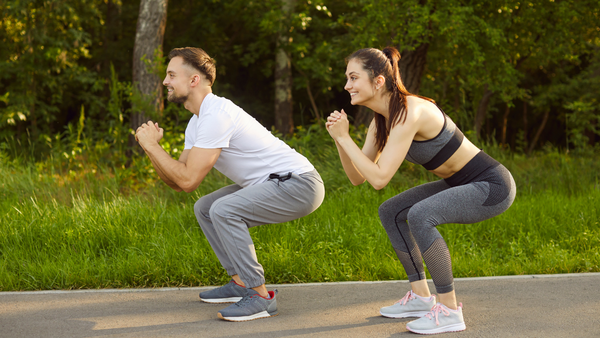
Everyday strength, also called functional strength, refers to the physical capacity that allows a person to perform daily tasks such as lifting, carrying, pushing, pulling, bending, and climbing, without strain or injury, this form of strength differs from purely aesthetic training, because it focuses on the ability of muscles, joints, and connective tissue to work together during real movements, rather than isolating a single muscle group, research in exercise physiology shows that training multiple joints and muscles at once produces greater carryover to daily activities, compared to isolated exercises performed on machines.
The Squat Movement
The squat is considered one of the foundational movements for everyday strength, because it mirrors the action of sitting down and standing up, a movement performed dozens of times per day, the squat trains the quadriceps, hamstrings, glutes, and lower back, while also demanding stability from the core and ankles, a simple way to visualize the squat structure is as follows:
Movement Phase — Muscles Involved — Daily Task Represented Descent — Quadriceps, Glutes — Sitting into a chair Bottom Position — Core, Hips — Picking up an object from the floor Ascent — Glutes, Hamstrings, Quadriceps — Standing up from a seated position
Regular practice of bodyweight squats, goblet squats, or barbell squats builds the strength required to rise from low surfaces, carry groceries up stairs, or lift a child, without placing excessive strain on the lower back.
The Hinge Movement
The hip hinge is another central movement for everyday strength, and it is distinct from the squat because the motion originates primarily from the hips rather than the knees, the deadlift, the kettlebell swing, and the Romanian deadlift are common examples of hinge exercises, this movement trains the posterior chain, which includes the hamstrings, glutes, and spinal erectors, the hinge is directly connected to tasks such as lifting a suitcase, picking up a heavy box, or moving furniture, without rounding the spine, studies on lower back injury prevention consistently show that people who train the hinge motion with proper control experience fewer strains during manual lifting tasks.
The Push Movement
Pushing exercises, such as the push up, the overhead press, and the bench press, train the chest, shoulders, and triceps, these muscles are engaged whenever a person pushes open a heavy door, pushes a shopping cart, or pushes themselves up from the floor, the push up in particular is valuable because it requires no equipment and trains the shoulders, chest, arms, and core simultaneously, a basic breakdown of the push movement can be shown as follows:
Exercise — Primary Muscles — Everyday Application Push Up — Chest, Shoulders, Triceps — Pushing open a heavy door Overhead Press — Shoulders, Triceps — Placing an object on a high shelf Incline Press — Upper Chest, Shoulders — Pushing a stroller or cart uphill
The Pull Movement
Pulling exercises balance the pushing motions, and they include the pull up, the row, and the lat pulldown, these exercises strengthen the back, biceps, and rear shoulders, muscles that are used when pulling open a door, dragging a heavy object, or pulling oneself up from a ledge or pool, a lack of pulling strength is commonly associated with rounded shoulders and poor posture, because modern daily life includes many pushing actions, such as typing and driving, but very few pulling actions, adding rows and pull-related exercises restores the balance between the front and back of the upper body.
The Carry Movement
Loaded carries, such as the farmer’s carry, the suitcase carry, and the overhead carry, train grip strength, shoulder stability, and core control, these exercises directly simulate the action of carrying grocery bags, luggage, or buckets, the farmer’s carry in particular is one of the simplest yet most effective exercises for building total body resilience, because it requires the entire body to remain stable while walking under load, a short comparison of carry variations is shown below:
Carry Type — Load Position — Primary Benefit Farmer’s Carry — One load in each hand — Grip and core stability Suitcase Carry — One load in a single hand — Anti-lateral flexion strength Overhead Carry — Load held above the head — Shoulder stability and control
The Rotation and Anti-Rotation Movement
Many daily activities require the trunk to rotate or resist rotation, such as swinging a golf club, twisting to reach a seatbelt, or carrying an uneven load, exercises such as the Pallof press, the woodchopper, and the Russian twist train the muscles that control rotation of the spine, the Pallof press is particularly valued in rehabilitation and strength settings, because it trains the core to resist unwanted rotation, rather than create it, a stable trunk reduces the likelihood of lower back discomfort during twisting motions performed in daily life.
The Single Leg Movement
Human movement is rarely performed on two legs at once, walking, climbing stairs, and stepping over obstacles all require single leg stability, exercises such as the lunge, the step up, and the single leg deadlift train balance, coordination, and unilateral strength, these exercises also reveal and correct differences in strength between the left and right side of the body, which can otherwise lead to compensations during walking or running, single leg training additionally challenges the stabilizing muscles around the hip and ankle, which are critical for preventing falls, particularly in older adults.
The Role of Core Stability
The core, which includes the abdominal muscles, the obliques, the lower back, and the deep stabilizing muscles surrounding the spine, functions as the central link between the upper and lower body, a strong core is not primarily about visible abdominal muscles, but rather about the ability to stabilize the spine during lifting, twisting, and carrying tasks, exercises such as the plank, the dead bug, and the bird dog train this stability without placing excessive load on the spine, maintaining core stability throughout life is associated with reduced risk of lower back pain and improved performance in nearly every daily task.
Programming Everyday Strength Training
Combining the movements described above into a structured routine ensures balanced development across the entire body, a sample weekly structure is shown below:
Day — Primary Focus — Example Exercises Day One — Squat and Push — Goblet Squat, Push Up Day Two — Hinge and Pull — Romanian Deadlift, Row Day Three — Carry and Core — Farmer’s Carry, Plank Day Four — Single Leg and Rotation — Lunge, Pallof Press
Training each of these movement categories two to three times per week, with adequate rest between sessions, allows the muscles and connective tissue to recover while progressively building strength, progression can be achieved by increasing resistance, increasing repetitions, or increasing the duration of carries and holds, gradually over weeks and months.
The Long-Term Value of Everyday Strength
Everyday strength training extends beyond the gym, because its primary purpose is to prepare the body for the physical demands of daily living, this includes lifting a suitcase into an overhead bin, carrying a child up a flight of stairs, or standing up from a low chair without assistance, research in aging populations consistently shows that maintaining functional strength through the movements described above is one of the strongest predictors of independence and reduced injury risk later in life, by training the squat, the hinge, the push, the pull, the carry, the rotation, and the single leg movement, the body develops the coordinated strength required for nearly every physical task encountered outside the gym.
Albert Mckennie is a strength and conditioning coach, author, and speaker with experience training athletes and general fitness clients.